
Time for the first DANGER CLOSE devlog! In this series, I’ll reveal more about how parts of the game work, leading up to the first release. Today: Offensive & Defensive Position!
I’ve written about this topic before; in a way, DANGER CLOSE is the culmination and formalizing of past blog posts, which is also how Block, Dodge, Parry came to be, so that makes me feel like I’m headed in the right direction!
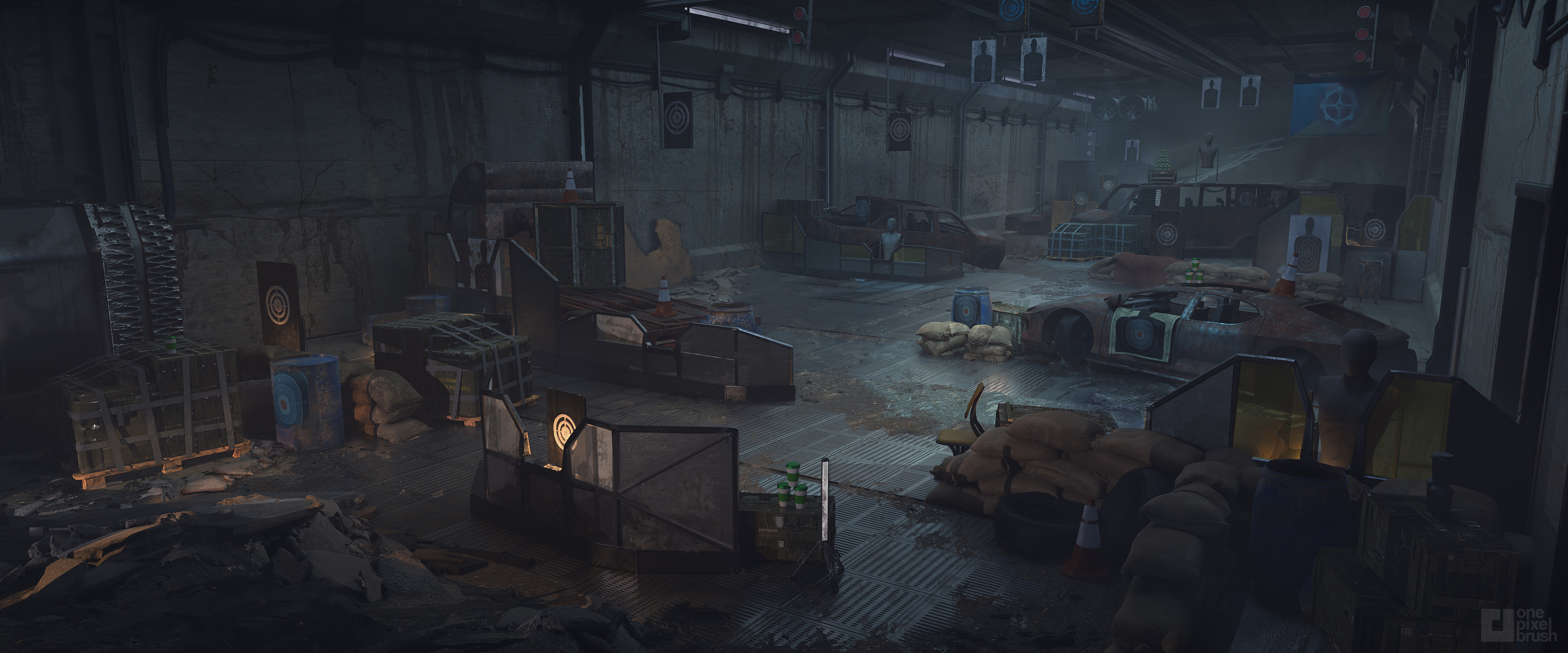
Image: SYNCED: Shooting Range by Ivan Martinez
In most TTRPGs, the tactical battlefield is built brick by brick: the GM lays out a map, describes the crates and concrete, the players poke around the scenery, and together you triangulate what’s possible. Alternatively, the GM gives a brief description, players ask questions, and the organic environment described is then assigned relevant rules.
Player: Do I see any I could take cover behind?
GM: There’s some concrete pillars to your left, yeah.
Player: Cool – I’ll run behind those. How much cover do they provide?
GM: Let me check the rules…
That works – but it can also bog things down, especially in a game like DANGER CLOSE, where tempo matters and combat needs to breathe, and we don’t want to get bogged down in minutiae too much. DANGER CLOSE isn’t about each individual bullet – it’s about the pressure and pushback of battle.

That’s where Offensive and Defensive Position come in: they’re abstractions designed to capture the fiction of battlefield movement without reconstructing every detail – or picking the tactics and approach first, and then interpreting what this might look like within fiction.
Instead of spending time figuring out whether a particular dumpster grants partial or full cover, you just say: “I want to move to a Fortified position.”
Mechanically, that gives you the best chance to survive the next volley.
Fictionally, it invites interpretation: maybe you dive behind a half-collapsed wall, maybe it’s a broken fountain, maybe it’s the burned-out husk of a civilian transport. The point is, the cover exists now because you made the move. And once this position has been interpreted as “broken fountain”, it can be used for further flavor and feed into the mechanics of the next turn.
This system flips the usual order. Instead of the GM declaring what’s on the battlefield and players reacting, players declare what kind of position they’re going for, and then together you narrate what that looks like in the current space.
If you’re fighting in a bombed-out car park and someone pushes for Fortified, well – there are probably still some concrete pillars standing, right? Let’s say they get behind one. It’s not about ignoring terrain; it’s about letting fiction flow from the decision, not gating the decision behind terrain. It’s tactical roleplay with the friction stripped out.
And when everyone plays along, the rhythm’s just right. One Trooper takes a risk to flank left, another falls back to Fortify the line, and suddenly you’ve got a full, messy, breathing battlefield – all built from three simple tiers of position.
Offensive & Defensive Position In Play
So, both Offensive & Defensive Position know 3 states, making for 9 potential combinations. I’ve tried to go for somewhat natural language; the word signals what it means. As I’ve currently written it:
Offensive Position:
- Limited: No clear line-of-sight on enemy; enemy behind cover.
- Engaged: Some cover/obstacles towards enemy.
- Flanking: Prime position to punish enemy and inflict heavy damage.
Defensive Position:
- Flanked: No cover, out in the open.
- In Cover: Some cover/obstacles to hide behind.
- Fortified: Good, solid cover and concealment.
Before an Engagement starts, the Advance Roll determines the starting position of the Squad, meaning that they might start Flanked + Engaged or In Cover + Flanking, or a variety of options in between.
Having a good Offensive Position (Flanking) deals more damage when attacking, having a bad one (Limited) lowers damage, or requires specific weapons or more ammo to effectively attack. Defensive Position lowers or increases the range on a d6 at which a Trooper gains Injuries.
And, of course, Offensive and Defensive Position are somewhat banded together; you probably can’t be Fortified and Flanking, so each Trooper has to constantly balance these elements, covering each other, and optimizing their offense and defense.
That’s all for now – see you in the next one!



Leave a Reply