
I love Warhammer 40k and its setting and scale. I do find that often, however, that scale is not really represented well – and that’s a shame! Playing the actual tabletop wargame still means playing only a small facet of the actual wars going on, and the TTRPGs are remarkably crunchy and are really focused on individual attack rolls and the like (which is part of the reason why I wrote DANGER CLOSE.
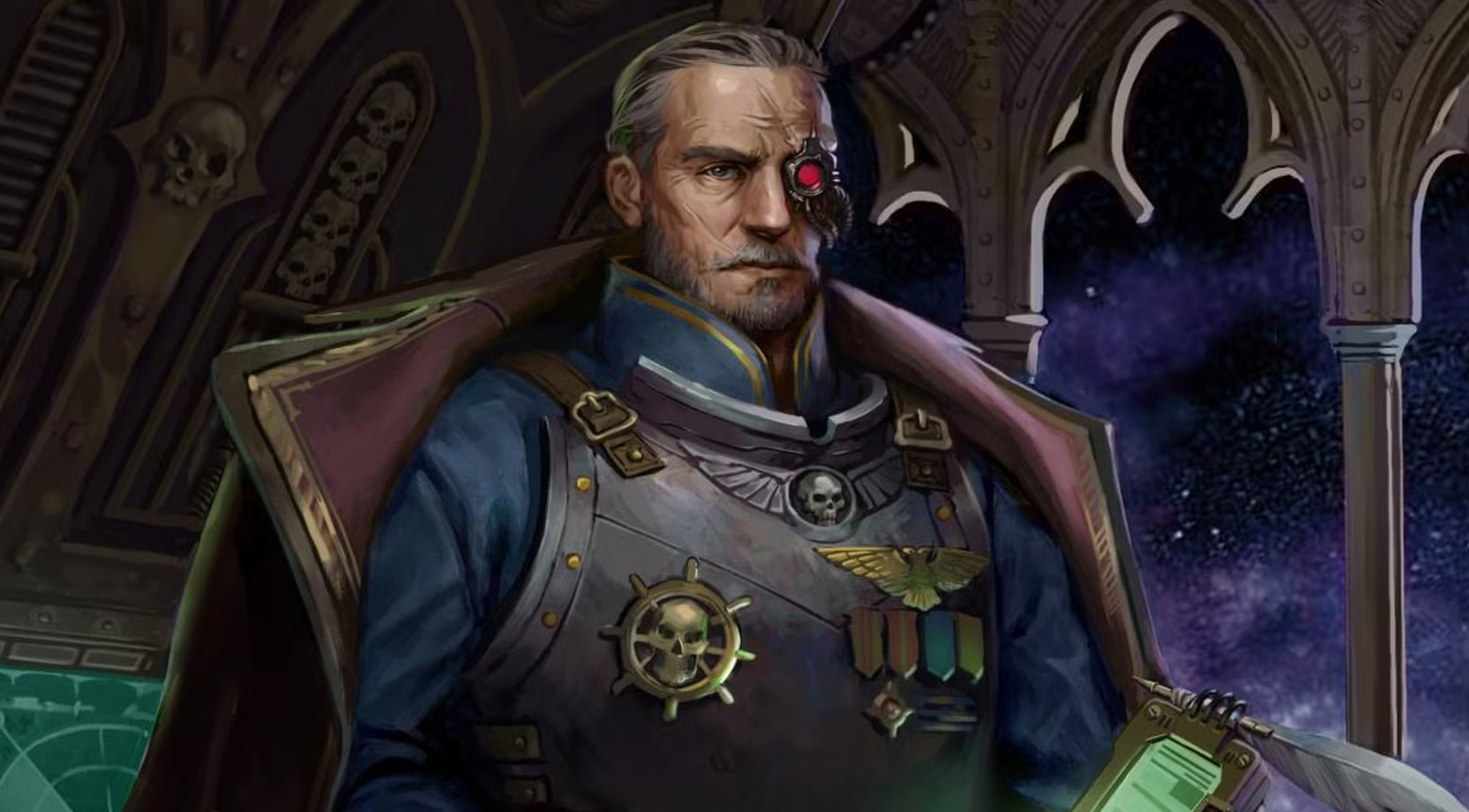
I found myself thinking of one particular subsetting/vibe of Warhammer 40k: Rogue Trader. I love the CRPG by Owlcat Games and how it conveys a sense of scale (though quite often, the Rogue Trader and their party are still doing a lot of thing themselves, but I get it!).
The Rogue Trader TTRPG is just as crunchy as Only War, and, in my opinion, doesn’t really capture the vibe of what it must be like to be a Rogue Trader – the fantasy of playing a Rogue Trader. Thus, I present a pretty rough draft of an idea below.
I am writing from the perspective of a Rogue Trader sci-fi game, but this can just as easy be used for medieval elfgame domain play, I think. It is definitely inspired by World Without Number – which I wrote about recently as well, in Solo-Roleplaying an OSR Mercenary Company Campaign.
Rogue Trader – A Layered Approach
Basic resolution mechanic: Roll 2d6+modifiers (ranging from -2 to +2), needing an 8+ to succeed on a normal task.
Attributes represent domains of action, not physical traits; what you can do, not what you are.
There are 4 main scales:
- Individual: The Rogue Trader themselves
- Retinue: Senior staff and officers; those that would accompany the Rogue Trader on missions and important events.
- Ship: The vessel’s properties, its crew and its assets.
- Domain: Planets, holdings and influence at large.
There are 6 main Attributes: Force, Cunning, Diplomacy, Expertise, Resolve and Wealth.
Force
The ability to apply violence, project power, and win conflicts through strength of arms.
Rogue Trader
Personal combat ability – swordsmanship, marksmanship, physical toughness. A Rogue Trader with high Force is dangerous in a duel and commands respect through physical presence. A low Force means they rely on others for protection.
Raised by: acquiring a master-crafted weapon, augmetic enhancement, surviving a brutal ordeal.
Lowered by: serious injury, age, losing a signature weapon.
Retinue
The martial capability of the Rogue Trader’s inner circle – the quality of bodyguards, the skill of the Master-at-Arms, the deadliness of the personal kill-team. High Force means the retinue can handle a firefight or boarding action without needing ship-scale support. Low Force means the retinue is made up of advisors, not fighters.
Raised by: recruiting a veteran warrior, outfitting the retinue with superior gear, a hard-won victory that bloods the team.
Lowered by: losing key combat personnel, a devastating ambush, equipment degradation.
Ship
Firepower, armsmen quality, and the ability to project violence from orbit to boarding action. This covers broadside batteries, lance strikes, fighter wings, and the thousands of armed crew who repel boarders or deploy planetside. High Force is a warship bristling with guns and hardened troops. Low Force is a trade hauler with a token security complement.
Raised by: refitting weapon batteries, recruiting a regiment of armsmen, capturing enemy ordnance.
Lowered by: battle damage to weapon systems, crew casualties, ammunition depletion after prolonged engagements.
Domain
Military strength at the strategic level – standing armies, planetary defense networks, orbital fortifications, and the capacity to wage or resist war across worlds. High Force means garrisoned worlds and a feared military reputation. Low Force means vulnerable holdings that rely on diplomacy or cunning to survive.
Raised by: conquering territory, building fortifications, forging a military alliance, recruiting from a warrior culture.
Lowered by: losing a war, rebellions that shatter the army, committing forces to a distant campaign and leaving holdings exposed.
Cunning
Deception, subterfuge, maneuvering around obstacles, and solving problems through misdirection rather than confrontation.
Rogue Trader
Personal guile – the ability to lie convincingly, notice when being lied to, slip through a checkpoint, or set up an ambush. A cunning Rogue Trader reads the room, plays factions against each other, and always has an exit strategy. Low Cunning means they’re straightforward to a fault – honest, perhaps, but easy to outmaneuver.
Raised by: pulling off a major deception, learning from a master spy, surviving a betrayal (and learning from it).
Lowered by: a public humiliation that reveals the Rogue Trader’s methods, overconfidence bred from too many easy victories.
Retinue
The intelligence and espionage capability of the Rogue Trader’s inner circle – spymasters, interrogators, saboteurs, and information brokers. High Cunning means the retinue can run covert operations, intercept communications, and eliminate problems quietly. Low Cunning means the retinue operates in the open, for better or worse.
Raised by: recruiting an ex-Inquisitorial agent, establishing an informant network, acquiring blackmail material on key figures.
Lowered by: a spy being turned, a botched covert operation that burns the network, losing a key intelligence asset.
Ship
The vessel’s ability to operate unseen or strike from ambush – running silent, masking energy signatures, deploying decoys, slipping through blockades. Also covers the ship’s internal security against infiltration. High Cunning is a vessel that appears where it shouldn’t be and vanishes before retaliation. Low Cunning is a ship that announces its presence across the subsector.
Raised by: installing stealth systems, recruiting a veteran helmsman, learning secret routes through a region of space.
Lowered by: damage to stealth systems, a well-known transponder signature, operating in heavily monitored space.
Domain
Spy networks, covert operations, the ability to destabilize rivals without open war. High Cunning means the dynasty knows its enemies’ secrets and can undermine them from within. Low Cunning means the domain’s intelligence is poor – vulnerable to surprise and unable to act in the shadows.
Raised by: establishing spy cells on rival worlds, turning an enemy agent, a successful campaign of covert destabilization.
Lowered by: a counter-intelligence purge, a double agent compromising the network, over-reliance on a single intelligence source that’s eliminated.
Diplomacy
Persuasion, negotiation, alliance-building, and the ability to get what you want through words rather than weapons.
Rogue Trader
Charm, intimidation, rhetoric, and personal magnetism. A Rogue Trader with high Diplomacy can talk their way into an exclusive audience, broker a ceasefire at a banquet, or cow a rival with sheer presence. Low Diplomacy means they’re blunt, off-putting, or simply unpersuasive – they need someone else to do the talking.
Raised by: a celebrated diplomatic triumph, earning the favor of a powerful figure, cultivating a reputation for fairness (or terrifying reliability).
Lowered by: a public insult or scandal, breaking a high-profile promise, cultural blunders in an important court.
Retinue
The diplomatic corps surrounding the Rogue Trader – envoys, translators, trade negotiators, and social fixers. High Diplomacy means the retinue can handle negotiations autonomously, maintain relationships across factions, and open doors the Rogue Trader doesn’t even know about. Low Diplomacy means the retinue lacks social finesse and every negotiation requires the Rogue Trader’s personal involvement.
Raised by: recruiting a skilled diplomat, a retinue member marrying into an important family, building long-term relationships with key contacts.
Lowered by: an envoy causing a diplomatic incident, losing a well-connected social operative, the retinue gaining a reputation for dishonesty.
Ship
The vessel’s ability to project authority and legitimacy – the impressiveness of the ship itself, the quality of its communication protocols, the hospitality of its state rooms. “Showing the flag” – arriving in orbit as a statement. High Diplomacy is a grand cruiser with gilded halls that hosts summits. Low Diplomacy is a battered raider that makes people nervous.
Raised by: refitting the ship’s state rooms, a famous victory that enhances the ship’s reputation, carrying an important dignitary safely.
Lowered by: visible battle damage left unrepaired, the ship being associated with a massacre or atrocity, a mutiny that becomes public knowledge.
Domain
Political influence, treaty networks, trade agreements, reputation among other powers. High Diplomacy means the dynasty is respected (or feared) at the negotiating table, with strong alliances and favorable trade terms. Low Diplomacy means isolation – few allies, poor terms, and a dynasty that others feel comfortable ignoring or exploiting.
Raised by: brokering a major treaty, hosting a grand conclave, a marriage alliance with another dynasty, establishing profitable and fair trade routes.
Lowered by: betraying an ally, losing a war publicly, a succession crisis that makes others question the dynasty’s stability.
Knowledge, technical skill, problem-solving, and the ability to understand and manipulate complex systems – whether arcane, technological, or scholarly.
Rogue Trader
Personal knowledge and intellectual capability – understanding of xenos cultures, Imperial law, Warp phenomena, trade economics, or forbidden lore. A Rogue Trader with high Expertise can hold their own in a debate with a Magos or recognize the signs of a Genestealer cult. Low Expertise means they rely entirely on advisors for anything requiring specialized knowledge.
Raised by: years of study, exposure to xenos artifacts, mentorship from a scholar or Magos, hard lessons learned from past mistakes.
Lowered by: Warp-exposure degrading the mind, trauma, losing access to key reference materials or mentors.
Retinue
The collective technical and intellectual capability of the Rogue Trader’s specialists – the Enginseer, the Navigator, the Chirurgeon, the Astropath, the Explorator. High Expertise means the retinue can solve problems the Rogue Trader can’t even understand. Low Expertise means critical gaps in specialist knowledge – no one aboard who can read the ancient map or repair the archaeotech device.
Raised by: recruiting a brilliant specialist, acquiring rare texts or data-stacks, a breakthrough discovery that deepens the team’s understanding.
Lowered by: losing a key specialist (death, madness, defection), encountering phenomena that defy all known frameworks, equipment failure that limits research capability.
Ship
The vessel’s technological sophistication – sensors, cogitator arrays, Warp drive reliability, the quality of the Enginarium, and the technical skill of the crew. High Expertise is a ship that can navigate treacherous Warp routes, detect hidden threats, and repair itself mid-battle. Low Expertise means systems are poorly understood, jury-rigged, or crewed by pressed gangers who barely know which end of a plasma conduit to point away from themselves.
Raised by: major refits, discovering and integrating archaeotech, recruiting skilled Enginseers, the crew gaining experience through long voyages.
Lowered by: catastrophic system failures, losing senior tech-priests, prolonged operations without access to a proper dock, Warp corruption of ship systems.
Domain
Infrastructure, research capacity, resource extraction efficiency, and institutional knowledge. High Expertise means well-maintained worlds with functioning manufactorums, educated populations, and the capacity to develop new technologies or exploit unusual resources. Low Expertise means crumbling infrastructure, lost knowledge, and an inability to maintain what already exists.
Raised by: founding a scholam or research facility, attracting Mechanicus cooperation, investing in infrastructure over generations.
Lowered by: brain drain as skilled people leave, destruction of key facilities, a tech-heresy purge that destroys knowledge alongside the heretical.
Resolve
Endurance, morale, discipline, and the ability to hold together when things go wrong. The defensive counterpart to the other attributes.
Rogue Trader
Willpower, mental fortitude, stubbornness, and the refusal to break. A Rogue Trader with high Resolve endures torture, resists Warp temptation, pushes through exhaustion, and makes hard decisions without flinching. Low Resolve means they crack under pressure – susceptible to fear, manipulation, despair, or the slow corruption of the Warp.
Raised by: surviving a harrowing ordeal, years of discipline, a defining moment of defiance that hardens the will.
Lowered by: prolonged Warp exposure, personal tragedy, accumulated trauma, witnessing something that shakes their faith in their purpose.
Retinue
The loyalty, cohesion, and morale of the inner circle. High Resolve means the retinue stands together under fire, keeps secrets under interrogation, and follows the Rogue Trader into hell. Low Resolve means fractures – secret resentments, wavering loyalty, the risk that someone breaks or betrays when the pressure mounts.
Raised by: shared hardship, the Rogue Trader demonstrating personal loyalty to their people, a victory that bonds the group, fair and consistent treatment over time.
Lowered by: the Rogue Trader sacrificing a retinue member callously, prolonged danger without reward, internal power struggles, discovering the Rogue Trader has lied to them.
Ship
Crew morale, discipline, and structural resilience – the ship’s ability to endure punishment and keep fighting. High Resolve is a disciplined crew that holds stations during a hull breach and a vessel that groans but doesn’t break. Low Resolve is a crew on the edge of mutiny aboard a ship held together with prayer and wire.
Raised by: a fair and respected captain, victory celebrations, shore leave, the Rogue Trader personally addressing the crew, a well-maintained vessel.
Lowered by: brutal Warp transits, heavy casualties, harsh discipline without justification, prolonged voyages without resupply, witnessing something truly horrifying.
Domain
Stability, loyalty of populations, resistance to rebellion, unrest, and corruption (both political and Warp-born). High Resolve means loyal worlds that endure hardship and resist outside influence. Low Resolve means a domain that is one crisis away from open revolt, succession wars, or Chaos infiltration.
Raised by: just governance over time, responding effectively to crises, cultural traditions that bind the population, visible protection against external threats.
Lowered by: famine, plague, heavy taxation without visible benefit, abandoning a world in its time of need, Warp storms or daemonic incursion shaking the population’s faith.
Wealth
Material resources, economic power, and the capacity to acquire, spend, and leverage money and goods. Exists only at Ship and Domain scale – personal wealth is abstracted into the dynasty’s assets.
Ship
The vessel’s cargo capacity, the value of its current holdings, trade goods in the hold, rare materials, and the quality of its provisions. High Wealth means the ship is well-supplied, carrying valuable cargo, and able to bribe, buy, or trade its way through problems. Low Wealth means empty holds, rationed supplies, and a crew wondering when they’ll next be paid.
Raised by: a profitable trade run, salvaging a valuable wreck, discovering a resource-rich system, receiving a major commission or payment.
Lowered by: piracy losses, expensive repairs, a trade deal gone sour, paying off a debt, bribing an entire space station.
Domain
The economic output and resource base of the dynasty’s holdings – mining operations, trade routes, tithes, manufactorum output, and accumulated treasury. High Wealth means the dynasty can fund wars, build ships, and project economic influence. Low Wealth means the domain is resource-poor or over-leveraged, unable to invest in growth or absorb shocks.
Raised by: establishing a new trade route, discovering valuable resources, conquering a wealthy world, decades of sound economic management.
Lowered by: losing a critical trade route, economic warfare from a rival, over-investment in a failed venture, the Administratum increasing tithe demands.
Additional Notes
- Attributes shift through play. Winning a war raises Domain Force. A Navigator going mad lowers Retinue Expertise. The game state is the character sheet.

- The Rogue Trader’s personal attributes are the most stable. The other three scales are more volatile, rising and falling with events. The Rogue Trader is the anchor.
- Cross-scale intervention: When a lower scale supports a higher one (or vice versa), grant +1. The Rogue Trader personally negotiating a domain-level treaty adds their weight to the roll – but they inherit the risk of that scale if things go wrong.
- This isn’t a full game yet, of course. If it’s anything, I’d say it’d have a solo focus.
The Condition Track
Each scale has four condition slots. When something goes wrong (a failed roll with consequences, a narrative setback, an enemy action) you write a short note in one of the slots describing what happened. These are fictional conditions, not abstract hit points: “Took a las-bolt to the shoulder,” “Chief Enginseer lost in the Warp,” “Trade fleet ambushed near Footfall,” “Southern continent in open revolt.”
When all four slots are filled, something breaks irreversibly. What that means depends on the scale:
- Rogue Trader: The Rogue Trader is out of action: dead, comatose, broken, captured, or otherwise removed from play. This is the most protected track in the game. It should take a lot to fill.
- Retinue: A key officer is lost: killed, turned traitor, gone mad, or simply departed. The retinue must be rebuilt in that area.
- Ship: Catastrophic system failure. The guns go silent, the hull is breached beyond repair, the crew mutinies, the Warp drive is dead. The ship needs a major refit, rescue, or replacement.
- Domain: Systemic collapse in that area. A world falls to rebellion, an army is routed and destroyed, the spy network is rolled up entirely, the treasury is bankrupt. Rebuilding takes significant time and effort.
Conditions also serve as negative modifiers at the table’s discretion. A Rogue Trader with “broken ribs” might not have their modifier reduced yet, but the GM could reasonably say that condition makes a particular action harder. The fiction is always right.
Clearing conditions requires time, resources, or specific action in the fiction. You don’t just heal; you recover, rebuild, recruit, repair. Some conditions might clear quickly (a minor wound, a temporary supply shortage). Others might linger for sessions or become permanent complications that never fully clear but can be replaced by new conditions if something worse comes along.
Wealth
Wealth is deliberately limited to Ship and Domain scale. The Rogue Trader’s personal finances are inseparable from their dynasty’s assets. If you need money, it’s a Ship or Domain problem. Wealth also fluctuates more freely than other attributes – a single lucrative trade run or a catastrophic loss can swing it dramatically. It’s the most volatile stat in the game.
Starting the Game
Character creation is lightweight. You don’t need to define everything up front; you build outward from the Rogue Trader.
To start, you need:
- The Rogue Trader. Distribute +3 points across the five personal attributes (Force, Cunning, Diplomacy, Expertise, Resolve). No attribute higher than +2, and you must take at least one attribute at -1. Every Rogue Trader has a weakness.
- The Retinue. Name two or three key officers. Distribute +4 points across the retinue’s five attributes, same limits. The officers you name inform what the high stats represent. If you have a Retinue Expertise of +2 and you’ve named a brilliant Enginseer and a seasoned Navigator, the fiction is clear.
- The Ship. Give it a name and a class (a brief description is fine; “battered light cruiser,” “ancient grand cruiser of uncertain provenance”). Distribute +3 points across Force, Cunning, Diplomacy, Expertise, Resolve, and Wealth (six attributes at ship scale). Same limits as above.
- The Domain. Most Rogue Trader stories begin with the Warrant and the Ship. The domain is earned through play. Claiming your first world, establishing your first trade route, raising your first army – that’s the campaign. When you establish a foothold, the Domain scale unlocks and you begin tracking its attributes, starting low and building from there.
Okay, that’s all I have for now. Abelard, thank the reader for their attention.
“Esteemed reader, on behalf of my Lord Captain, I extend formal gratitude for your attention, your discipline, and your commendable allocation of time. Your readership is duly noted in the proper ledgers.
You may now return to your ventures – better informed, I should hope.”


Leave a Reply