
I came across 2×71 by emmy on Itch.io, a new version of the original 1978 rules for Gamma World. Browsing through them, I came across an idea that I think deserves a spotlight: Artifact Examination & Experimentation.
To be very clear: this is not my idea, not is it emmy’s – this idea is present in the original 1st edition rules of Gamma World. I’m just highlighting it for inspiration!
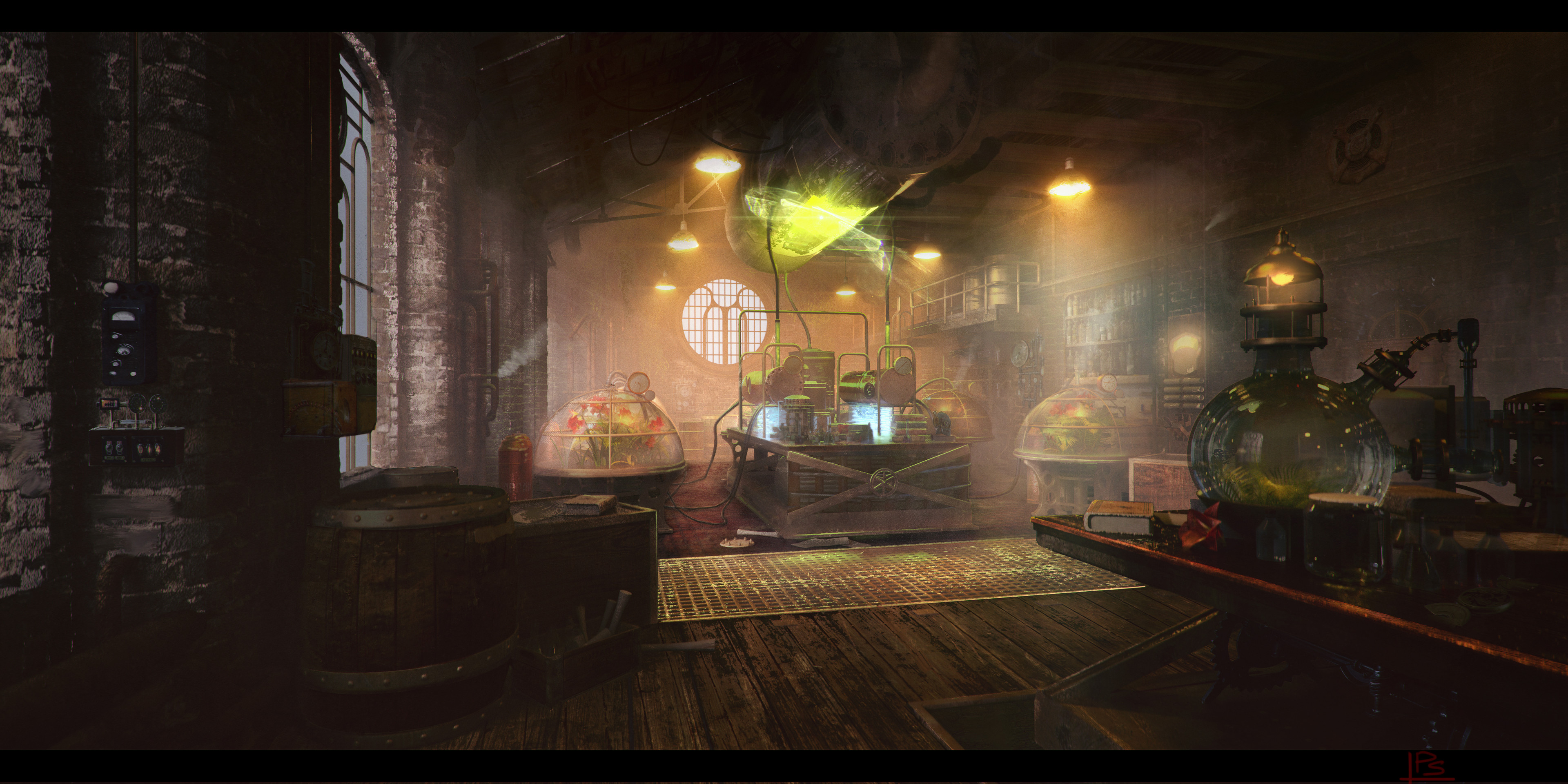
Image: Steampunk Factory by Sergei Panin
2×71’s Version
Flowcharts are used to simulate the process of examination and experimentation.
- Place a token on the space marked S.
- Roll a d10 and move the token in the indicated direction based on the result. You can spend a route turn examining an artifact, which gives you 20 rolls on the chart. Spending 6 search turns will give 5 rolls on the chart.
- When you reach F, you learn how the artifact functions.
- If you reach X, the referee rolls a d10 for the items chance of functioning, to see if it activates on its own. Then they roll a d10 again, with a 1-in-10 chance for the item to short circuit or explode.
- Any amount of time can be spent on examination. However if interrupted, you must start again at S.
- Most items will require energy cells to function.
2×71, emmy


Gamma World’s Version
ARTIFACT USE AND OPERATION: Once players have found an artifact, they will not automatically know what it is for, or how it works. It is quite possible that one will fiddle with an artifact for weeks and never determine what it is, or, in the other extreme, detonate a bomb, eliminating everything within 100 meters. The three following charts are used to simulate experimentation with artifacts.
Place a marker on the space marked “S”. Generate a number between 1 and 10, and move the marker to the next space indicated. When the marker has been successfully moved to the space marked “F”, the player has determined what the artifact is for, and how to use it. Moving to a space marked with a skull and crossbones means that the player has hurt himself or one or more of his companions (if it is possible to harm anyone with the item). He has, in any case, failed to determine how to work the artifact and must start again at “S”.
Five rolls on any of the above charts requires that the player do nothing else but concentrate on and manipulate the artifact for one hour (each additional player concentrating adds one die roll per hour). Players may spend as much time as they wish trying to figure out artifacts, but if a session is interrupted, or stopped for some reason, the player must begin again at start. Players with very high or low intelligence, and certain mutations, are given minuses or allowed plusses on the die rolls.
If a result calls for harm, or if a player discovers the use of an artifact and tries it out, the referee must roll percentile dice, according to the artifact’s chance of functioning, to see whether anything happens. It is possible to determine the use of an artifact, even if it does not work (because of its condition). The referee must roll percentile dice again: if it is possible for the artifact to short out, or explode, it does so on a result of 1–10, causing damage (to be determined by referee), otherwise no harm comes to anyone.
Chart A is for simple items such as pistols, bombs, and other items with only a few simple switches or operating mechanisms. Chart B is for medical machinery, robotic devices, and other equipment with multiple controls and indicators. Chart C is for very complex devices, such as computers, think tanks, or portions of a space ship.
Bear in mind the fact that most inoperative artifacts only require new or recharged batteries to make them work. (Equipment was well made in the 24th century). Experience is awarded for figuring out how to work artifacts, regardless of whether or not they actually do work. Experience is also awarded for a robotic unit for mastering it or for defeating it in combat.
Gamma World, James M. Ward, Gary Jaquet


Summarized
The charts differ a bit between versions, but the core rules remain the same:
- 1d10 for a number, follow where it goes
- Possibility of failure (starting over) and harm (damage to player)
- Different number of rolls based on a set time invested in investigating
- Charts of varying complexity, depending on the artifact researched
I love how this procedure is essentially system-agnostic, and captures the complexity of experimenting/tinkering with something you don’t quite understand. I could see this have cool uses depending on various settings, with the ‘time’ element being useful to add pressure/a ticking clock.
- In fantasy settings, it could be used to study arcane manuscripts or learning scrolls.
- In modern settings, it could be used for hacking or operating machinery.
Some things I’d consider adding:
- Positions A, B and C could be fleshed out to give interesting partial information or functionality.
- A notably skilled tinkerer could roll 2d10 and pick the most favorable result.
- Charts could be styled into something setting-appropriate; a switchboard and circuitry for something modern/futuristic, or perhaps a tea-stained paper with scribblings around it for an in-person fantasy-themed setting.
What do you think – do you see possible uses for this?



Leave a Reply