
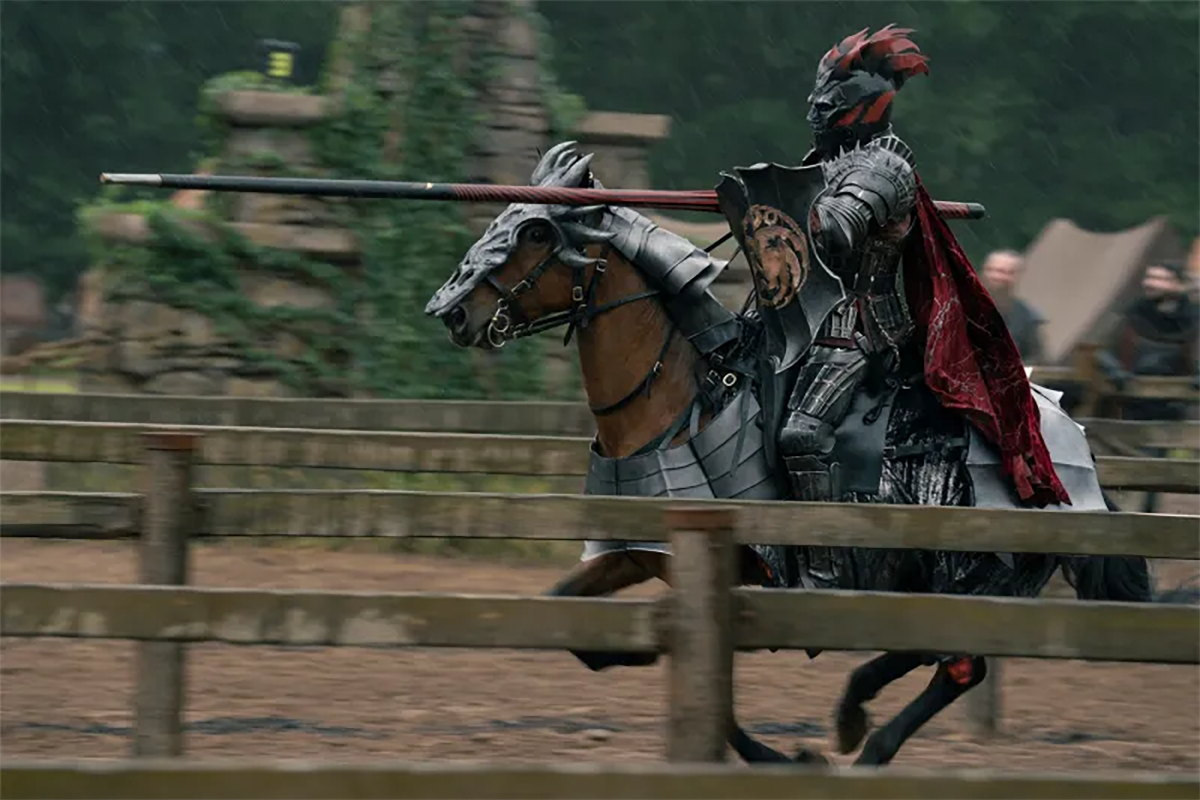
Simple rules for jousting in Block, Dodge, Parry, because yes, I have also been watching A Knight of the Seven Kingdoms.
We’re using the basis of our dueling rules for this – as found in Steel & Survival.
A pass consists of 3 steps. Whenever a contest is made, both jousters make a Save. The highest successful roll wins. The winner rolls twice on their next Save, keeping the better result. If no one succeeds, no jouster gains an edge.
The Charge
Ride forth with great haste. A battle of wills, and control of one’s horse. Involves a WIL contest. Being firmly bonded with one’s horse, a skilled rider and/or having more at stake in this joust (be it honor or otherwise) can grant an edge; either an automatic success, or a reroll on a failed WIL Save.
The Encounter
Try to place your lance so that it will dismount the opponent. Involves a DEX contest. Being a notable skilled jouster might grant an edge (or having won the Charge WIL contest).
More dishonorable options are available, and do not require a DEX contest:
- If a rider decides to aim for their opponent’s head, they have a 2-in-6 chance of hitting it.
- Striking the horse has a 5-in-6 chance of seriously injuring the opponent’s horse.
Hit or miss, both these options are clearly acts of dishonor, and will come with fitting ramifications. If you use them, make them count.
The Aftermath
Assuming both riders aim for each other’s body/shield, both riders make a STR Save to see if they can stay mounted. The loser of the DEX contest in the Encounter stage first takes 1d8 STR damage (non-lethal, lessened by Armor).
If a rider is struck in the head, they take 1d8 & 1d12 (keep highest) STR damage and make a STR Save to not die (lessened by Armor). The rider is thrown off regardless.
If a rider’s horse is struck, it takes 1d8 & 1d12 STR damage, and makes a STR Save. The rider is thrown off regardless.
Riders either continue to make passes until one is dismounted or until 5 rounds have passed – or duke it out in the mud.


Leave a Reply