
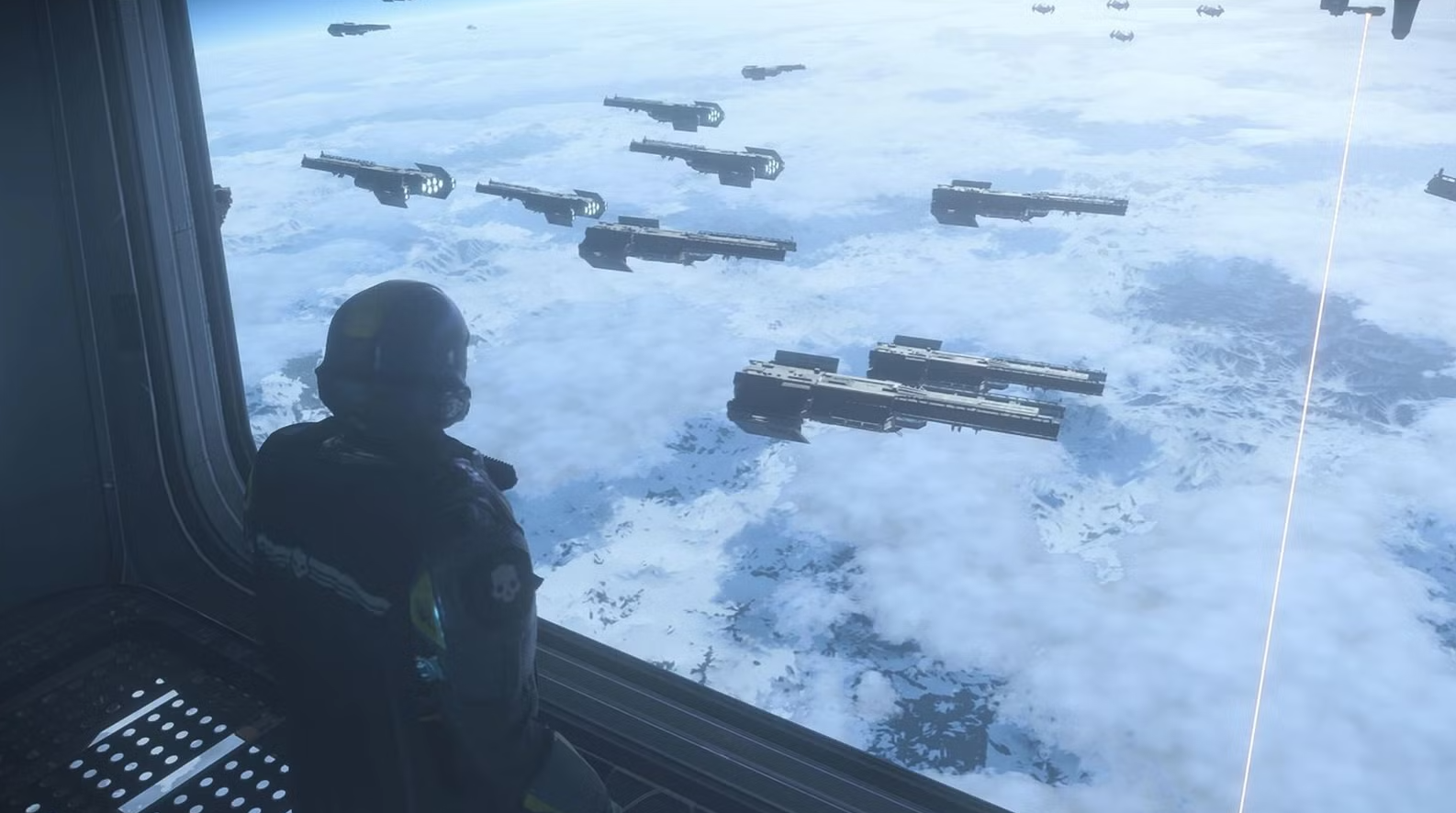
Helldivers 2 was a major inspiration for DANGER CLOSE, my solo tactical military sci-fi skirmish TTRPG – so since very early development, I started to wonder: what if… what if we threw together a server of players of DANGER CLOSE, with me acting as the GM, writing cool missions for players which they then complete on their own, reporting back with the results, and the narrative flowing from that?
So… that’s what I did.
DANGER CLOSE is in a quite complete form (version 0.96.5, as of writing), and given that it’s both a roleplaying game with emergent narratives as well as a mostly-theatre-of-the-mind tactical skirmish TTRPG, more playtesting and feedback is more than welcome.
I also decided to just… go and give this server idea a try.
The Setup
The basic idea is as follows: The players play as squad commanders of a (purposefully somewhat generic, because further defined by play) military branch of the Colonial Alliance Expeditionary Force, who have set up shop on a wild and dangerous alien planet about 50 years ago.

A few other factions vie for control of the planet and its resources, which gives us more than enough powder kegs to set fuses to. The server consists of the following channels:
- Comms Room. Basic lore information, as well as a reflection of in-universe intel for the Commanders. News reports, rumors, intel reports, developing situations. Read-only.
- Conference Room. A place where in-universe polls determine the direction of the CAEF. This ranges from “Should pets be allowed on base?” to “Where do we send ammo?” to “Should we try diplomacy, a show of force, or stealthy operations on this particular foe?”
- Ops Center. A forum set-up where new missions are posted. Players respond with their After-Action Reports. I generate new missions based on the developing situations. Based on the outcomes of these missions, new intel flows through the Comms Room and Conference Room, which means new missions. The arbitration here is purposefully left open – I don’t set hard thresholds, but act like, well, a normal GM. Trying a mission very hard (with most Squads failing) can still yield results.
- Admin Office. Where new squads are registered, and users promoted to Active Duty.
- Common Room. In-character interactions and roleplay between active duty members.
- Mess Hall. Out-of-character chat and debrief, updates.
- Wall of Remembrance. Where we honor bravely fallen troopers.
A key notion is that this is built to scale to whatever it needs to be. If I would only have two active players, I would still progress the story based on their general efforts; however, if 50 people were to play, everything can still scale and fit the story. The missions are framed such that it can be somewhat handwaved that multiple squads would undertake them. It’s not about taking down one key installation. There just happens to be a region with quite a few key installations, and every squad does their own attempt at taking one of these down.

I use LegendKeeper for (completely optional) extra bits of lore, and for me to keep track of main events.
Notes Thus Far
I designed DANGER CLOSE as a tactical military skirmish game for solo and co-op play. Five Troopers, a handful of Sectors, a mission that plays out in under an hour. It’s fast, lethal, and generates story through play rather than through scripted narrative beats. You get attached to your Troopers because of what happens to them, not because you wrote a backstory.
That makes it perfect for this format, for a few specific reasons.
It plays solo. The entire system is designed to work without a GM at the table. A player can pick up a mission, generate their Sectors, run through the Exchanges, and have a complete tactical experience on their own. That’s non-negotiable for an asynchronous campaign where dozens of people might be running the same mission at different times across different time zones.
It’s fast. A mission takes maybe 30 to 60 minutes. That’s the right cadence for play-by-post. Nobody’s committing to a four-hour session. You grab a mission when you have time, play it, file your debrief, and you’re done. The war keeps moving whether you play one mission this week or five.
It degrades gracefully. Things go smoothly until they don’t, and then they spiral. But even a desperate situation is fun to play. A squad wipe isn’t a punishment; it’s the most dramatic debrief you’ll ever write. The system makes losing interesting, which is critical for a campaign where the collective outcome depends on honest play.
The Commander’s Toolkit provides the campaign layer. Mass combat rules are standing by, which I’ll use to depict big events. The whole toolkit is designed to sit on top of the core game and provide exactly the kind of strategic scaffolding a persistent campaign needs, without turning into a second game bolted onto the first.
Debriefs are the product. In a traditional TTRPG, the experience is the session itself. In this format, the experience is the debrief – the after-action report that gets posted in the forum thread. DANGER CLOSE generates the kind of play that produces good debriefs naturally. Tactical decisions, desperate moments, unexpected casualties, clutch rolls. A paragraph or two is enough to capture what happened, and reading other people’s debriefs is half the fun.

Come Check It Out!
If any of this sounds like your kind of thing, the server is live and the war is ongoing. You can lurk, read the debriefs, follow the developing situation in the Comms Room, or register a squad and jump in. The Basic Rules for DANGER CLOSE are free, which is all you need to play!




Leave a Reply