
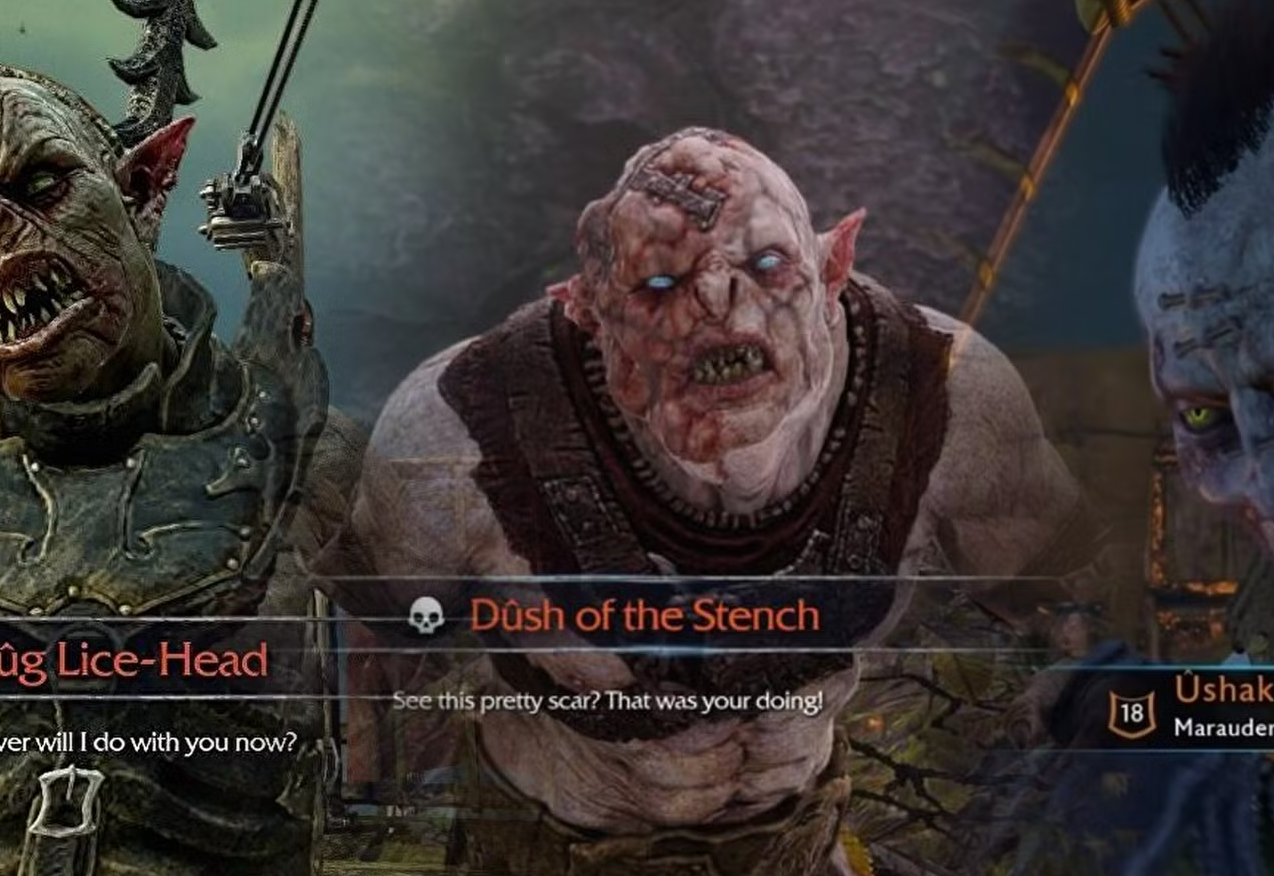
A proposed method to simulate (certain parts of) that very addicting gameplay loop from a certain Lord of the Rings game. Completely setting/system agnostic; all of this can apply to royal houses, military structures, mafioso, conspiracy structures, rival cookie-baking grandmas.
As a refresher:
Oh, and the Nemesis System is patented by Warner Bros. Games.
I was pointed to this amazing post by Zak H., which I think acts as an amazing companion piece:
Hack the Nemesis System into your RPG
The Basis
Triangles
We start with our core building block: the triangle.

A triangle consists of 3 actors: a superior and two underlings. When we create a triangle, we roll 1d3 to determine which relationship we give further definition. In this example, I rolled a 3, so Underling B gets a defined relationship with their Superior.
Relationships
Relationships exist in 2 categories: Superior/Underling and Underling Rivalry. Furthermore, a Relationship can be in one of 5 states:
- Hatred (-2). The actors move into direct Conflict with each other.
- Unfavorable (-1). These actors are at odds with each other.
- Neutral (0). The default. We do not note this in our diagram.
- Favorable (+1). These actors have a positive bond.
- Loyal (+2). These two actors share a deep bond. If one of the actors enters a Conflict, the other will take their place, acting as a bodyguard. In a Superior/Underling relationship, this is generally the Underling protecting the Superior, not the other way around.
This can be rolled for with a d6: on a 1-3, the relationship is Unfavorable, on a 4-6 it’s Favorable.

Archetypes
Each actor gets an Archetype, which dictates personality and methods. It also comes into play in Conflict.
- Cunning. Uses scheming, feints and tricks. Advantage against Brutal.
- Brutal. Raw force, strength, displays of power. Advantage against Disciplined.
- Disciplined. Rigorous training, routine, drilled reflexes. Advantage against Cunning.
- Unpredictable. Whenever an actor’s Archetype comes into play, roll 1d3 to pick one of the above Archetypes. This actor will act according to that Archetype in this instance. Roll again each Conflict.
This creates a simple rock-paper-scissors dynamic, with a built-in wildcard.
We can roll for this with a d4.

Conflict
Conflict is a clash between two actors, triggered when their relationship hits -2. Conflict always has a winner and a loser, with the loser removed from the dynamic. Whether this means death, defeat, exile or dishonor is up to the context of the setting and system.
Conflict is contextualized by the type of Relationship:
- Superior/Underling: The Underling seeks to supplant the Superior.
- Underling Rivalry: The Underlings seek to eliminate each other.
Archetypes and their matchups determine the winner. A simple resolution could be:
Determine who is the attacker in fiction (the Underling attacking the Superior, or one of the rival Underlings). Roll 1d6. On a 4+, the attacker wins. If the Archetype is favorable to the attacker, roll 2d6, keep highest. If it’s favorable to the defender, 2d6, keep lowest. If the Archetypes are identical, it’s a flat 1d6.
If an Underling slays their Superior, they ‘move up’. If we take our example, and assume that Underling A has slain the Superior, it now looks like this.

In this case, I’d argue that Underling B now looks Unfavorable upon the new Superior/former Underling A. After all, Underling B had a good relationship with the former Superior. So, we make the relationship a -1 now – a good powder keg for the future.
We now have an empty spot! This means a new Underling is generated, and fills the spot of Former Underling A.
Unless… Unless… Unless we start stacking triangles.
Stacking Triangles
Now it’s getting interesting. We now have 3 triangles (blue, green, red).

I haven’t even rolled for relationships yet, and we can already see some very interesting emergent dynamics here. The core expansion to Conflict is that empty spots get filled by conflict from underlings.
In our example above: If Smith and Harris duke it out, and Harris loses, Peters and King will duke it out to fill Harris’ vacant spot. And if Peters and King had previous animosity, we move that along as well (in whatever way makes sense).
Similarly, if Smith were to go for the throne of Boss Jones and win, Myers and Walker would fight over who gets Smith’s Lieutenant position.

This single move could leave the red triangle awfully vacant:

But there’s always new up-and-comers looking for a spot.
As a rule of thumb, I would start (and try to keep it) at one defined relationship per Triangle, as these can quickly stack up. Then again, you can make it as storied and complex as you want.
Similarly, I would keep relationships limited to their own triangles. It becomes awfully complicated if Peters suddenly wants to bump off Walker.
Interactivity: Okay, Now Make It Do Something
Okay, I think that’s easy enough:
Passage of Time
Once every [time unit] – I don’t know, downtime, in-game week, month, after every Major Event – roll for an existing Relationship (1d3 for our three-triangle model) and alter it. Roll 1d6: On a 1-2, it normalizes/moves towards or stays at 0. On a 3-6, it moves further towards the outer ends (either Hatred or Loyalty).
For wilder results, only roll for relationship, and always move it to further extremes.
Player Action
This is where we can get really creative:
- (Lack of) Knowledge. To begin with, players might not even know how big the full diagram is, let alone who’s in it. Names, relationships, archetypes become valuable quest/mission rewards.
- Targeted Hits. Mounting an attack on an actor can create major shake-ups, that can have unforeseen consequences.
- Manipulation. Target a Relationship, with a mission/quest guaranteeing to modify the bond. Generally, players will want to worsen a relationship, but improving it can also be an option – perhaps if the party has dirt or leverage on a low-ranking Sergeant, and benefits from seeing them rise through the ranks.
Room for Improvement and Expansion
Some things I haven’t included here, as I consider this a good starting point/base framework:
- Certain archetypes might prefer certain types of actions.
- Higher ranks might have more power, becoming harder to defeat (or harder to reach at all).
- More archetypes, with different features.
- Certain positions in the org chart (or certain Archetypes) being responsible for elements of the enemy’s larger operation. Brutal actors might lead foot soldiers, cunning actors run the spy network. Taking them out affects the enemy operation as a whole.
- Personal history with the actors. That cool thing where Grablard the Once-Beheaded comes back to haunt you. I’m not sure this needs mechanical adaption? I don’t want to be lazy, but I feel that the framework above is a good base system to just go hog-wild with, once stories and patterns start emerging in gameplay. A table of “How Was This Sergeant Defeated?” writes itself, I think.
- The takeover mechanics found in the videogame. I actually don’t quite remember this as well, and I don’t feel like looking it up now, but I seem to remember placing your own agents within the larger structure? You’d slowly fill it up? My fault, I suppose, from writing this based on my memory of the system, as opposed to actually looking it up again.
I’m more than curious to hear your opinion – let me know below!
(And no, zero AI was used in writing this post. I have used, and will continue to use, my beloved -minus symbol as part of my writing style.)
While I Have You Here…
The seed of this idea partially sprouted out of brainstorming for my Discord play-by-post campaign for DANGER CLOSE, my tactical military skirmish TTRPG. The fact that I’ve been designing a solo RPG is quite visible in the above design as well, I think. You can check it out below – and the base rules are free!




Leave a Reply